※本產品原廠代理從國外進口,有些交期較長,下訂前請詢問!
PI5581,Pololu原廠 5V升壓模組(U3V9F5)Step-Up Voltage Regulator
*5V Step-Up Voltage Regulator U3V9F5 固定5V輸出


| Output voltage | Typical max continuous input current* | Min input voltage |
| 5V | 900mA | 2.6V |
此系列包含六種固定輸出電壓,電壓範圍從5V到24V不等:
- U3V9F5: Fixed 5V output 固定5V輸出
- U3V9F9: Fixed 9V output 固定9V輸出
- U3V9F12: Fixed 12V output 固定5V輸出
- U3V9F15: Fixed 15V output 固定12V輸出
- U3V9F18: Fixed 18V output 固定18V輸出
- U3V9F24: Fixed 24V output 固定24V輸出
The different versions of the board all look very similar, so you might consider adding your own markings or other distinguishing features if you have multiple versions that you need to be able to tell apart./
不同版本的棋盤看起來都非常相似,如果你有多個版本需要分辨,可以考慮加入自己的標記或其他區別特徵。

【Overview】
The U3V9Fx family of boost (step-up) voltage regulators generate higher output voltages from input voltages as low as 2.6 V. They are switching regulators (also called switched-mode power supplies (SMPS) or DC-to-DC converters) and have typical efficiencies between 70% and 95%.
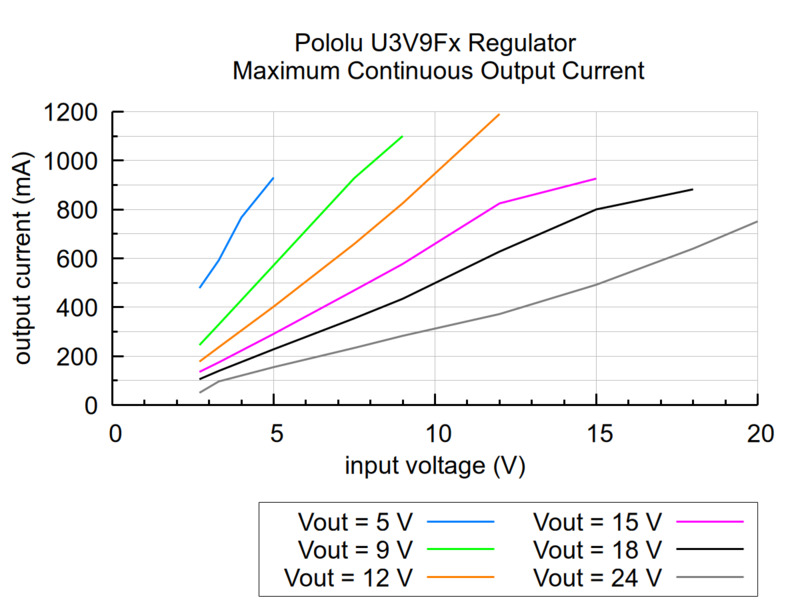
The regulators actively limit the instantaneous input currents to 2.2 A when boosting, and input currents up to around 900 mA can typically be maintained for many minutes without triggering thermal shutdown, though the actual performance depends on the input and output voltages as well as external factors such as ambient temperature and airflow. For boost regulators, the output current equals the input current times the efficiency divided by the boost ratio of VOUT to VIN, so the more you are boosting, the lower the maximum output current will be (see the maximum continuous output current section below for performance graphs).
These regulators have several built-in protections, including cycle-by-cycle input current limiting and over-temperature shutdown.
【警告】:此升壓穩壓器採用典型的拓樸結構,透過電感器和二極體將輸入端連接到輸出端,沒有任何元件完全阻斷電流路徑。
*因此,如果輸入電壓超過設定的輸出電壓,則輸入電壓會傳遞到輸出端,短路或其他過載情況會損壞穩壓器。
*此外,此穩壓器還存在以下問題:不是具有內建的防反向電壓保護功能,但也可以額外購買反向電壓保護模組來添加此功能。
【Details for item #5581】
〔Features and specifications〕
- Output voltage: 5 V with 4% accuracy
- Input voltage: 2.6 V to 20 V (Note: input voltages above 5 V will pass through to the output)
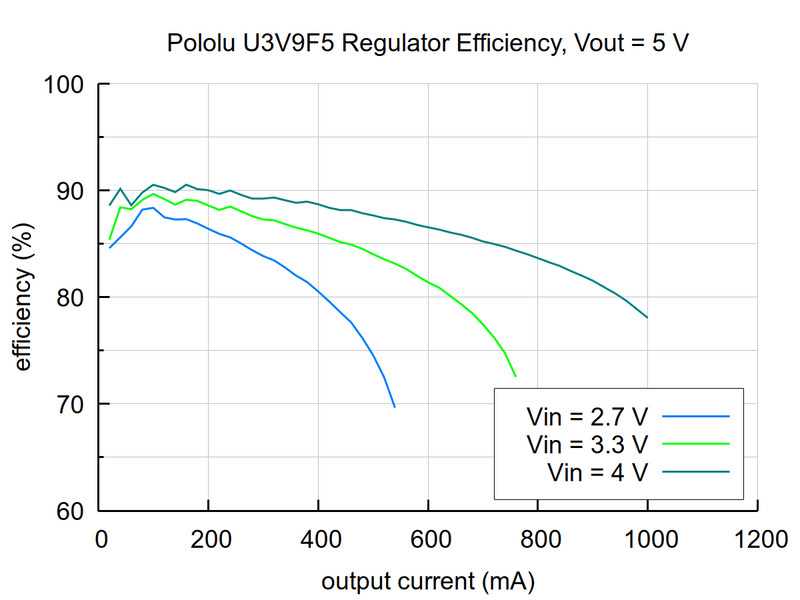
- Typical efficiency of 70% to 90%, depending on input voltage, output voltage, and load (see the efficiency graph below)
- Switching frequency: ~1.6 MHz under heavy loads
- Power-save mode that increases light load efficiency by reducing switching frequency
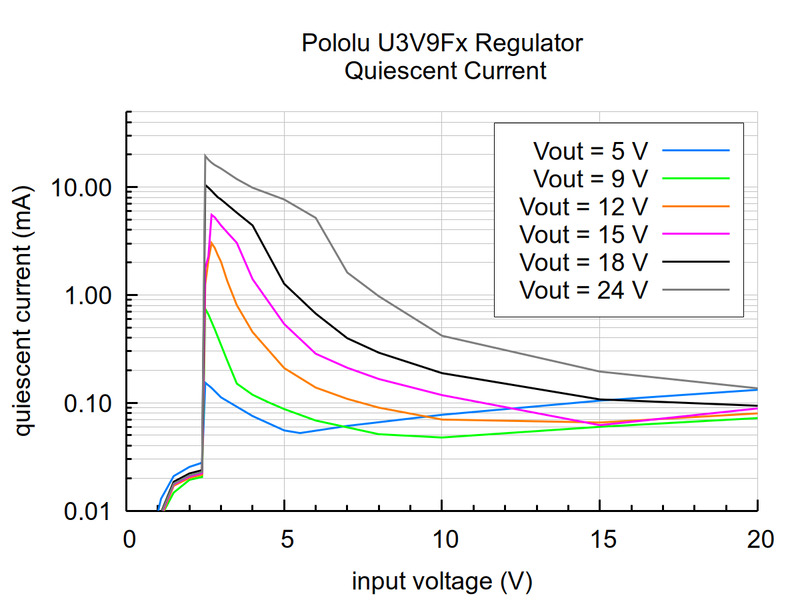
- Typical no-load quiescent currents under 0.2 mA (see the quiescent current graph below)
- 2.2 A switch current limit
- Typical continuous input currents up to around 900 mA (see the maximum continuous output current graph below)
- Tolerates input voltage above output set voltage (output will track input, see the connections section for details)
- Integrated protections:
- Over-temperature shutdown
- Soft-start feature limits inrush current and gradually ramps output voltage
- Cycle-by-cycle peak input current limiting
- Compact size: 0.54″ × 0.34″ × 0.11″ (13.6 × 8.6 × 2.8 mm)
- Weight: 0.4 g
〔Connections〕

The input voltage, VIN, must be at least 2.6 V and should not exceed 20 V. Please note that if VIN is higher than VOUT, the higher input voltage will show up on the output, which could be dangerous for your connected load if it cannot tolerate that higher voltage. The regulator itself should generally be able to tolerate such pass-through voltages as long as they do not exceed 20 V and the load is not trying to draw currents through the regulator that are beyond what the regulator can withstand.
VOUT is the regulated output voltage. The regulator’s soft-start feature gradually ramps up the VOUT voltage on start-up to limit in-rush current draw. The U3V9Fx regulators do not have short-circuit protection, so they could be damaged if exposed to output shorts or excessive loads, and they do not have reverse-voltage protection. Reverse-voltage protection modules are available separately that can be inserted between the power supply and these regulators to protect them from accidental reversal of input power polarity.
The connections are labeled on the back side of the PCB and are arranged with a 0.1″ spacing along the edge of the board for compatibility with solderless breadboards, connectors, and other prototyping arrangements that use a 0.1″ grid. You can solder wires or 0.1″ headers directly to the board.
Note: header pins are not included with this product, but 1×3 straight male headers and 1×3 right-angle male headers are available separately.
〔Typical efficiency〕
The efficiency of a voltage regulator, defined as (Power out)/(Power in), is an important measure of its performance, especially when battery life or heat are concerns.
〔Maximum continuous output current〕
The maximum achievable output current is approximately proportional to the ratio of the input voltage to the output voltage. Additionally, the maximum output current can depend on other factors, including the ambient temperature and air flow. The graph below shows the typical maximum continuous output currents these regulators can deliver at room temperature with no forced airflow or heat sinking.
在正常運作時,這種產品可能會熱到燙傷你。操作此產品或相關元件時請特別小心。
〔Quiescent current〕
The quiescent current is the current the regulator uses just to power itself, and the graph below shows this for the different regulator versions as a function of the input voltage.